
Legendary filmmaker James Cameron, known for revolutionizing cinema through technology, has taken a firm stance against the rise of AI-generated actors and synthetic performances. Speaking to CBS Sunday Morning during the promotional tour for his upcoming film Avatar 3: Fire and Ash, the director said that the idea of AI-created performers is “horrifying” and fundamentally opposed to what filmmaking should be.
“That’s exactly what we’re not doing”
Despite being one of the biggest adopters of motion-capture technology, Cameron drew a sharp line between performance capture and generative AI.
He praised motion capture as a kind of collaboration that keeps human performance at the heart of the process — a way to enhance actors, not replace them.
In the interview, he described performance capture as:
“A celebration of the actor–director moment.”
But when asked about generative AI models capable of creating actors, performances, or entire scenes with a text prompt, he didn’t hold back:
“They can make up a character. They can make up an actor. They can make up a performance from scratch with a text prompt. It’s like, no. That’s horrifying to me. That’s the opposite. That’s exactly what we’re not doing.”
Cameron emphasized that he has no desire to reduce or remove the role of human actors from his films.
“I don’t want a computer doing what I pride myself on being able to do with actors. I don’t want to replace actors, I love working with actors.”
AI is limited to remixing the past, says Cameron
Interestingly, Cameron is not anti-technology in general. He is a director of the UK-based AI company Stability AI, and his career has been defined by pushing visual effects and cinematic tools to their limits.
However, he believes generative AI’s creativity is fundamentally restricted by how these systems are built. Because AI models are trained on years of existing human work — art, scripts, performances and more — he argues they cannot truly originate something new.
“What generative AI can’t do is create something new that’s never been seen. The models are trained on everything that’s ever been done before; it can’t be trained on that which has never been done.”
According to Cameron, this means AI will always feel like a blended remix of what already exists:
“You will innately see, essentially, all of human art and human experience put into a blender, and you’ll get something that is kind of an average of that.”
For him, this “average” approach can never replace the unique lived experiences that real writers and actors bring to a story. He points out that what audiences connect with are the quirks and specific humanity of the people behind the characters:
“So what you can’t have is that individual screenwriter’s unique lived experience and their quirks. You won’t find the idiosyncrasies of a particular actor.”

The future: human performance becomes “sacred”
Rather than predicting a future where AI actors dominate the screen, Cameron believes the opposite may happen: authentic human performance will become even more valuable.
As synthetic content becomes easier to generate, real-time artistic creation by a human being could feel rarer and more meaningful to audiences.
“It also causes us to have to set our bar to a very disciplined level, and to continue to be out-of-the-box imaginative. The act of performance, the act of actually seeing an artist creating in real time, will become sacred.”
His comments arrive at a time when the film and TV industry is wrestling with the implications of AI-generated extras, voice cloning, and the possibility of fully digital performers. Unions, studios and technologists are all debating how far AI should be allowed to go in replacing or augmenting human talent.
Cameron’s perspective adds a powerful voice to that debate — especially because it comes from someone who has consistently reshaped what is technically possible on screen, from The Abyss and Terminator 2 to Avatar and its sequels.
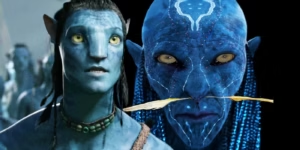
Avatar 3 keeps humans at the core of the technology
Despite his criticism of generative AI for acting and storytelling, Cameron shows no sign of slowing down on the technology front. The upcoming Avatar 3: Fire and Ash continues the franchise’s signature approach: cutting-edge visual effects built on top of real human performances.
Actors still perform on set and in motion-capture studios, with advanced CGI and world-building layered on top. For Cameron, this is the ideal balance — technology as a tool in service of human creativity, not a replacement for it.
As AI tools evolve and spread across the creative industries, Cameron’s message is clear: the future of cinema isn’t about swapping actors for algorithms, but about protecting and elevating the human element at the heart of every story.